A Playground for Experimentation
When most people think of “experimental beer,” they picture the latest release from a craft brewery. But commercial brewing, even at its most creative, is limited by needs for profitable margins, consistency, and to appeal to a broad audience. In my opinion, the real work of experimenting with various batches is in homebrewing, where the only question I tend to ask is: What boundary do I want to push?
Sometimes the boundary is flavor. I once asked myself, “how smoky is too smoky?” (a question I suspect others have made and a flavor I wouldn’t recommend repeating). But failure is part of the process. While I might lose a batch, I don’t have to worry about investors, market share, or turning off a first-time customer who may never return after tasting a missed attempt.
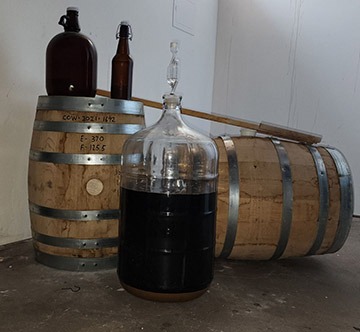
Other times, the challenge is technical. I brewed a 100% rye beer once, and it was stickier than I ever imagined. Lautering took forever, but eventually I managed 10 gallons (38 L) of rye wort, which I fermented and aged in a rye cask. The payoff was worth the effort: A beer that tasted like liquid bread, dense and spicy, unlike anything I’d ever had.
That kind of curiosity also took me back in time. Working with Primer’s Yeast, I set out to brew with the oldest yeast I could find. I pulled together ingredients from Yemen, Egypt, and Israel — stuff no commercial brewer would ever attempt to source at scale. The result was a beautifully floral, unhopped sour beer. Brewing it at home made the impossible possible.

Experimentation has also taught me more about yeast than I ever expected. At one point, I pushed a strain to its absolute limit with a 25% ABV beer that adhered to Reinheitsgebot, the German beer purity regulations. What was initially to be a 10-gallon (38-L) batch of beer ended up being 15 gallons (57-L), after accounting for nearly 100 lbs. (45 kg) of liquid malt extract additions.
With the addition of nutrients to help the yeast reach its full potential, and after a few stalls, the beer reached 25% ABV and I tucked it into a Bourbon barrel for a year. Commercially, the logistics of a beer like that would be a nightmare, especially when needing to change course quickly and decisively. At home, it was just a test of patience and persistence.
Now I’m working on a beer made entirely from chestnuts. Chestnuts bring starch, not enzymes, so brewing with them requires a whole new approach. Also, due to the low proteins in chestnuts it has minimal amounts of free amino nitrogen (FAN), therefore Fermaid O and diammonium phosphate (DAP) are required. The final issue is that adding too much of an enzyme may result in an extremely dry beer and limit the head.
What ties all of these beers together is simple: They only make sense in a homebrewing context. Commercial brewers, even when they chase innovation, have to stay within guardrails of efficiency and marketability; homebrewers don’t. That’s why the bleeding edge of beer belongs to the thousands of curious tinkerers experimenting in kitchens, garages, and basements. We’re the ones resurrecting lost traditions, testing unconventional ingredients, and seeing how far yeast and process can be pushed.
To me, homebrewing isn’t just a hobby; it’s the frontline in establishing new flavors and techniques while searching for that “lager in the rough” you’ll remember drinking years from now. But it all starts with a question: What boundaries can I push?