Recreating 3,000-Year-Old Beer
The project began with a deceptively simple question: What is the oldest brewable yeast available to us today? That question set me on an 18-month journey that would combine history, archaeology, and brewing science in a way few projects ever have.
After researching multiple strains of yeast, I came across a German company called Primer’s Yeast (which, unfortunately, is no longer in business). The company had collaborated with researchers at Tel es-Safi, an ancient brewery site, where yeast cells dating to around the 9th century BCE were recovered from the interior surfaces of ceramic vessels once used for fermentation. Yeast can survive in a dormant state for astonishing lengths of time, especially when trapped in porous materials like clay.
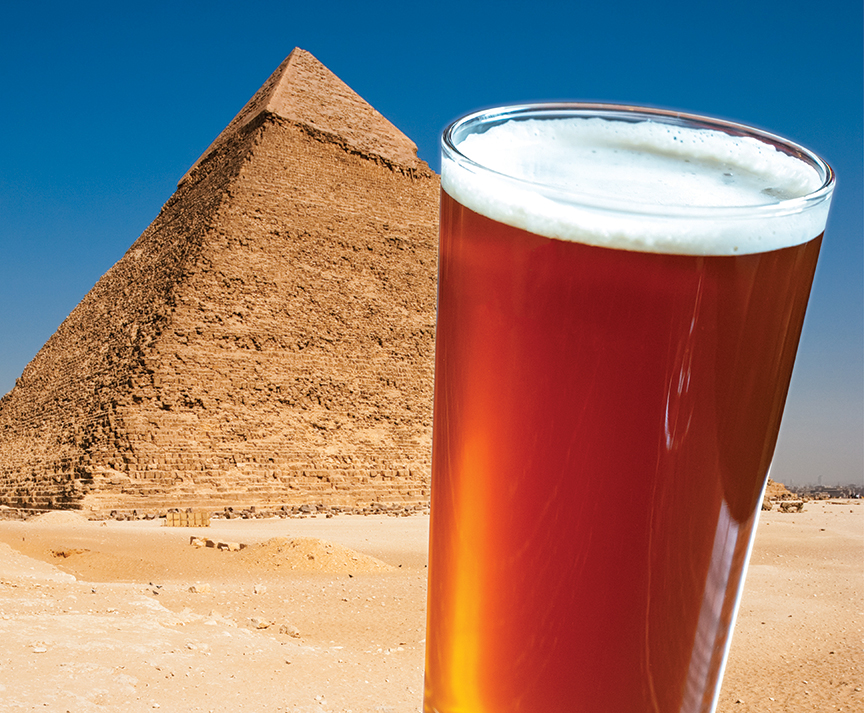
At Tel es-Safi, researchers carefully extracted microscopic samples from the inner walls of ancient brewing vessels. These samples were cultured under sterile conditions, and genetic sequencing confirmed that the organisms were indeed brewing yeasts rather than environmental contaminants. The site itself, identified as the Philistine city of Gath, has long been associated with large-scale beer production, and excavations indicate industrial-scale activity during the Iron Age. Household-level brewing is also attested in the region. For me, the idea that living cells could persist for nearly three millennia and then be coaxed back into activity was as compelling as the beer they would eventually produce.
I have both a B.A. and an M.A. in Middle East Studies and have spent years studying the culture and history of the Levant, a historical region in the Eastern Mediterranean, making the discovery irresistible. After many back-and-forth discussions with Primer’s Yeast, I was able to secure a sample of this ancient yeast — and an opportunity to brew a beer that someone living nearly 3,000 years ago might have recognized.

The idea of reviving ancient yeast was not entirely new. In 2019, Seamus Blackley, best known as the creator of the Xbox, made headlines when he worked with an Egyptologist and a microbiologist to extract dormant yeast from Old Kingdom Egyptian vessels. He used it to bake bread with ancient grains like emmer and barley. The bread, he said, was sweeter and richer than modern sourdough. His Twitter (now X) thread documenting the process went viral, sparking global fascination with the idea of tasting history. If bread could be reborn from antiquity, why not beer? That question lingered in the cultural imagination, and my project picked up the thread, shifting the focus from the oven to the fermenter.
Of course, saying you are going to brew a 3,000-year-old beer is much like saying you are going to make ancient ice cream. There is no way to absolutely recreate the conditions, flavors, and ingredients of antiquity. The water, the mineral content, the starches, and the fermentables all differ from what they were millennia ago. Yet there are general attributes that remain recognizable across time. For beer, “recognizable” rests on three pillars: The grains and adjuncts available in the region, the equipment and heating methods that shaped flavor, and the fermentation practices that determined acidity and carbonation.
In the Eastern Mediterranean of the late Bronze and early Iron Ages, open-vessel fermentations at ambient temperatures probably produced beers with low natural carbonation and a gentle acidity. The result was likely a beverage that, while not identical to modern beer, would still have been recognizable to ancient drinkers — lightly smoked, gently sour, floral, and only faintly carbonated.
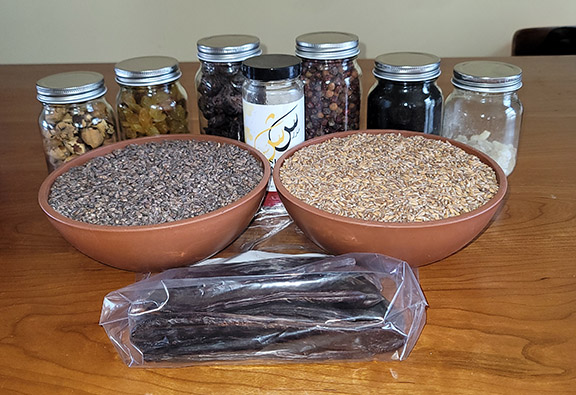
The first step in recreating such a beer was to identify the correct ingredients. I began by combing through academic articles and primary sources, searching for evidence of what ancient brewers used. What I found was a great deal of conjecture. The base ingredients were clear enough — barley and, to a lesser extent, emmer wheat — but the adjuncts were far more uncertain. Many articles mentioned dates, figs, grapes, and other fruits, but the amounts varied wildly, and the resulting flavors could swing dramatically depending on the proportions. Fruit adjuncts were certainly common as foods and sweeteners in the period, but precise brewing ratios were rarely preserved. This made primary sources all the more valuable.
Eventually, I turned to the Ebers Papyrus, one of the longest surviving Egyptian medical texts. Written around 1550 BCE during Egypt’s New Kingdom, the papyrus was purchased in Luxor in the 19th century but likely originated in Thebes — the city we now call Luxor — at a time when the Temple of Karnak was rising as one of the largest sacred complexes in the world. This was the era of Amenhotep I, when Egypt was reemerging as a powerful, unified state after the expulsion of the Hyksos.

The papyrus contains hundreds of prescriptions, many of which mention beer both as nourishment and as a vehicle for plant preparations. Crucially, it offered not only lists of ingredients but also amounts. This allowed me to analyze and organize the data, identifying the most common adjuncts and their typical proportions.
After reviewing the recipes, removing ingredients that appeared rarely, and comparing the amounts of more common ingredients across different entries, I settled on eight adjuncts. These would function much like an ancient form of gruit, the herbal mixture once used to flavor beer before hops became dominant. The papyrus helped ground the project in a text that has survived more than three millennia and offered a rare glimpse into the culinary and medicinal practices of the time.
Still, there was another challenge. The names of ingredients listed in ancient texts do not always correspond neatly to the plants we know today. To ensure accuracy, I cross-referenced the papyrus with Dr. Howard Carter’s notes on the botanical specimens found in the tomb of Tutankhamun, who died in 1323 BCE. By comparing the recipe with the archaeological record, I was able to confirm the identity of the ingredients and then purchase them from sources as close to the Levant as possible. With the recipe finalized, I prepared to brew a 10-gallon (38-L) batch. This step was crucial because without careful cross-referencing, the project could have easily slipped into guesswork rather than scholarship.
The backbone of the beer was purple Egyptian barley, 10 lbs. (4.5 kg) in total. Barley has always been the primary fermentable in beer, and archaeological surveys in the Nile Valley routinely recover barley from New Kingdom layers. Experimental malting of ancient landraces has shown high variability in enzyme activity, so using a heritage-type barley was a reasonable way to approximate the past. Scholars have estimated ancient beer to range from very low to relatively high alcohol content, so I chose a middle ground of about 5% ABV. This strength seemed plausible for both everyday consumption and special occasions. Fortunately, a local source was able to provide heirloom purple Egyptian barley, making the choice both historically grounded and practically feasible. Choosing this heritage barley was a way to echo the flavors of the past, since the character of the grain itself would have shaped the beer as much as the brewing process did.
To complement the barley, I added 5 lbs. (2.3 kg) of emmer wheat. Emmer was another grain commonly identified in ancient brewing, and malting it seemed appropriate. I also chose to acidulate and smoke the emmer, reasoning that the fires used to heat the wort in antiquity would have imparted a smoky flavor while also offering some antimicrobial protection. This aligned with targeting a sour profile consistent with warm, open fermentation. The smoking process was simply a reflection of necessity in the ancient world, but in this case gave the beer a rustic quality that modern drinkers often associate with artisanal craft brewing.
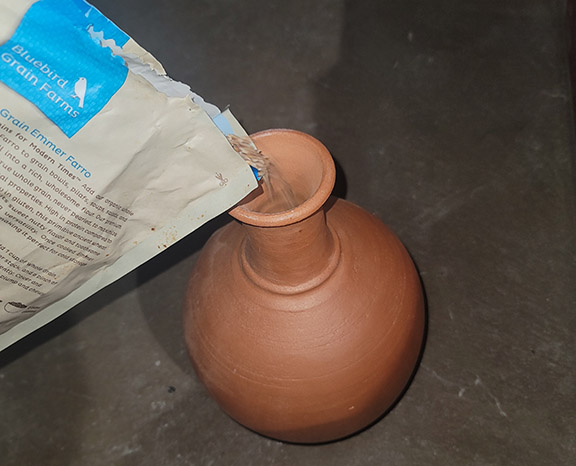
I considered brewing the mash in a clay vessel to mirror ancient practice, but ultimately used modern equipment for safety and temperature control. Archaeological evidence shows that Iron Age kilns were capable of firing pottery to high strengths — strong enough to withstand repeated heating — and even early glass production was underway in the Near East by the 9th century BCE. While glass was mostly used for ornaments and small vessels, its very existence demonstrates that artisans of the time had mastered high-temperature control. Some experimental archaeologists suggest that ancient brewers may have dropped heated stones into the mash to raise temperatures, a method that leaves telltale scorch marks on ceramics. Acknowledging these possibilities gave the project a deeper sense of plausibility, even if the recreation ultimately relied on stainless steel rather than clay.
The adjuncts added complexity and depth. Four cups of desert dates, also known as Egyptian balsam fruit, contributed sweetness and richness, much as they still do in porridge today. Four cups of golden raisins, purchased from Israel to remain geographically authentic, provided another layer of fruitiness. Four cups of sycamore figs, identified in Tutankhamun’s tomb, added their distinctive flavor; these were sourced from just outside the gates of Karnak Temple in Luxor, linking the figs directly to the city where the Ebers Papyrus was penned not two hundred years prior. Four cups of Yemeni Sidr honey, derived from the Christ’s Thorn tree also found in Tutankhamun’s burial goods, connected the recipe to the same New Kingdom world that produced both the papyrus and the Valley of the Kings. Two cups of prickly juniper berries lent a resinous note, while two cups of carob fruit added sweetness and body. Half a cup of black cumin introduced a subtle heat that highlighted the floral notes, and half a cup of Hojari frankincense contributed a powerful aroma that initially overwhelmed the beer but later mellowed into a beautifully integrated floral character. All of the adjuncts with the exception of the honey and frankincense were added to the boil (those two ingredients were added after cooling the wort below 95 °F (35 °C) to keep the properties present in the wort).

Once the ingredients were combined, the yeast pitched, and fermentation allowed to run its course, the beer was bottled without added carbonation. Some scholars argue that ancient beer was consumed quickly after brewing, but there is also evidence that it was stored for festivals, feasts, and future use. In such cases, preservation would have been necessary, and my decision to bottle and condition the beer for a week reflected this possibility. The week of conditioning also allowed the flavors to meld, softening the sharper edges of the frankincense and balancing the sweetness of the fruit with the acidity of the fermentation.
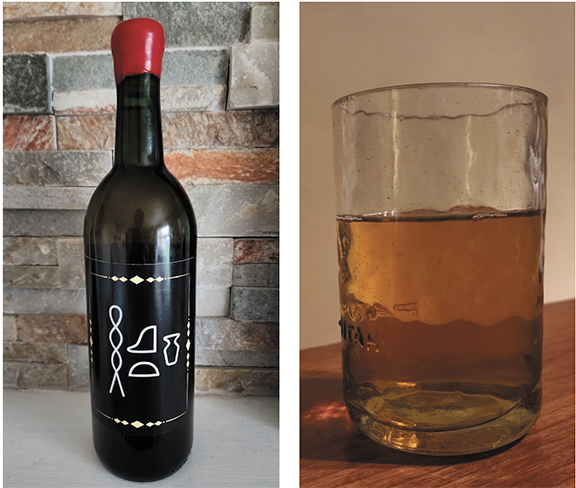
When the beer was finally ready, I held tastings in a variety of settings. The most common reaction was surprise at how refreshing it was. Again and again, tasters remarked that it was easy to imagine drinking such a beverage after a long day in the desert sun. It was floral, sour, lightly smoked, and gently carbonated — a flavor that lingered in memory. Tasters compared it to a German Gose — light, refreshing, slightly salty, and sour, with notable fruitiness. Some noted hints of apricot alongside the floral finish, flavors that lingered long after the glass was empty.
The beer eventually earned the name “Sinai Sour,” a nod to its Levantine focus and tart profile. It was unlike anything on tap at a modern brewery, yet it felt familiar, as if it belonged to the same long tradition of human fermentation. To drink it was to experience a continuity between ancient and modern practice, grounded in ingredients, method, and result. From the industrial brewers of Iron Age Gath to the household recipes preserved in the Ebers Papyrus, the Sinai Sour echoed a spectrum of ancient beer culture. It was not just a beverage, but a bridge across time.
Sinai Sour, All-Grain
(10 gallons/38 L, all-grain)
OG = 1.047 FG = 1.004
ABV = 5.6%
Ingredients
10 lbs. (4.5 kg) purple Egyptian barley
5 lbs. (2.3 kg) smoked, acidulated emmer wheat
1 lb. (0.45 kg) rice hulls
4 cups desert dates
4 cups Israeli golden raisins
4 cups sycamore figs
2 cups prickly juniper berries
6 oz. (170 g) carob fruit (~2 cups)
½ cup black cumin
½ cup Hojari frankincense
4 cups Yemeni Sidr honey
Primer yeast [can substitute Wyeast 2565 (Kölsch) or SafAle K-97]
Step by step
I started by malting, acidulating, and smoking the emmer wheat. Also, in individual jars, soak the dates, figs, raisins, juniper berries, and carob fruit in just enough water to cover.
On brew day, crush barley and emmer wheat and combine with rice hulls for a step mash beginning with a 30-minute protein rest at 131 °F (55 °C). Follow with 30-minute rests at 147 °F (64 °C) and 157 °F (69 °C). Mash out at 172 °F (78 °C) and sparge to collect 11.5 gallons (43.5 L) in the kettle.
Remove the soaked adjuncts and set the liquid aside for later. Add all of the adjuncts with the exception of the honey and frankincense to the boil kettle and boil for 60 minutes.
Cool to 95 °F (35 °C) and stir in the liquid from the soaked adjuncts as well as the honey and frankincense. Cover and allow to cool to room temperature overnight.
Transfer wort to a sanitized fermenter for two days to allow to sour. Then pitch yeast and allow to ferment/rest for one month before transferring to a secondary to condition an additional two weeks.
Bottle without the addition of priming sugar.