Bear Chase Brewing Co.
Dear Replicator, I recently had and loved Evenin’ Sunset IPA from Bear Chase Brewing in Virginia. It had a great blend of everything I enjoy in an IPA: A clean malt profile with excellent hop character. I would love to hear some tips for a replication!
David Ackerman
Richmond, Virginia
Set against the rolling landscape of western Loudoun County, Virginia, Bear Chase Brewing Company occupies a piece of land with a story. The farm, first recorded in 1905 as “Bonnie Brae” (Gaelic for “Pleasant Hill”), earned its name in the 1980s when the owner’s dogs would frequently chase black bears across the property. When five friends partnered to purchase the farm in 2017, they kept the name and fulfilled a dream: To create a place to “hang out and drink with their friends.”
Head Brewer Ken Wilson’s journey to the brewhouse first began in the kitchen. “For most of my life I have been a chef,” Wilson says. “I discovered homebrewing in 1996 when I attended the Culinary Institute of America in Hyde Park, New York.” In an era before the craft beer boom had fully reached the East Coast, he says, “If you wanted good beer, you needed to brew it.”
After years of balancing a demanding career as a chef with a passion for homebrewing, he finally made the leap and turned a hobby into a new business venture.

“By the time I turned 40, the stress and long hours from working in kitchens had caught up with me and I knew I needed a new career,” Wilson says.
He started at Bear Chase as an assistant brewer, eventually taking the helm as Head Brewer. His background gave him a unique perspective on the transition.
“Running a brewery is a job,” he admits, citing equipment maintenance, managing supplies, and planning as the bulk of his work. “Luckily, my experience as a chef and running large catering operations helped prepare me for the ‘job’ part of what I do.”
While the hazy IPA Evenin’ Sunset is the recipe we’ll focus on, let me first share more about this brewery’s wide range of styles. Unlike some tasting rooms you may walk into and find an assortment of IPAs with a few hop substitutions to differentiate them, Bear Chase offers a wide array of styles to meet customer demand. “We attract a wide range of customers and for us it is important to have a broad variety of styles,” Wilson says.
Their Kölsch has won back-to-back silver medals at the World Beer Cup and a gold at the Great American Beer Festival (GABF). Their Oktoberfest has also taken home gold twice at GABF. They’ve also got rotating beers throughout the year from easy-drinking American styles like their light “Beer Merica!” and a blonde ale, as well as a hefeweizen, amber lager, oatmeal stout, and a line of hard seltzers, with other styles rotating in the mix too.

That chef’s palate and pragmatic approach are evident in Bear Chase’s flagship juicy IPA, Evenin’ Sunset. It’s a beer that perfectly balances intense aromatics with a soft body, though in fact, it was at first a beer born from an accident.
“The beer came about by mistake, actually,” Wilson recalls. “We used to have an IPA on the menu called Mornin’ Sunrise. One brew day five years ago, we were brewing it and came to realize we didn’t have the Mosaic® hops we needed for the recipe.” Facing a brewhouse dilemma, the team had to think fast. “So we pivoted and put together a different hop combo and got Evenin’ Sunset. The recipe has been tweaked a lot over the years, but it remains a favorite.”
That new hop combination — Callista, Simcoe®, and Citra® — wasn’t just a random substitution, but rather an exercise in careful flavor structuring. Wilson chooses his hops as deliberately and precisely as a chef would choose spices.
“I tend to classify hops into three categories: Soft, punchy, and supportive,” he says.
According to Wilson, soft hops, like Callista, have a more balanced alpha-to-beta acid ratio and produce softer flavors. Punchy hops, such as Citra®, are the stars that drive the profile. Supportive hops, like Simcoe®, have flavors that add complexity and play a supporting role.
“Callista is a soft hop with German parentage; green pineapple is the dominant flavor,” Wilson says. “This pairs great with Citra® and helps mellow it out a little. The Simcoe® is added for support to give more complexity to the hop profile.”
Contrary to the strategy taken by many modern IPA brewers, however, Wilson suggests that more is not always better. “We actually removed 30 percent of the hops from the original recipe of Evenin’ Sunset and our customers liked it better. Try to find balance.”
Wilson draws inspiration from the fact that the beer industry, much like the recipes of an adventurous brewer, is always in flux.
“One of the things I love about this industry is that it is always changing. I am constantly learning how to make new products or improve my methods.”
With that, know that this recipe from the brewer is their current iteration. What you see next year may not be the same, but, like Bear Chase, feel free to adapt it to your preferences as they evolve!
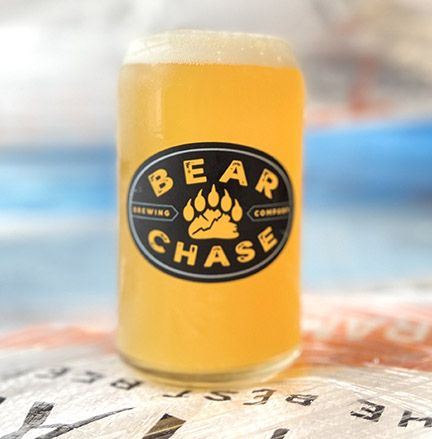
Bear Chase Brewing Co.’s Evenin’ Sunset clone, All-Grain
(5 gallons/19 L, all-grain)
OG = 1.075 FG = 1.018
IBU = 40 SRM = 5 ABV = 7.5%
Ingredients
12 lbs. (5.4 kg) North American Pilsner malt
1.8 lbs. (0.8 kg) Weyermann Carafoam® malt
14 oz. (410 g) dextrose (corn sugar)
2.5 oz. (71 g) Callista hops (5 min.)
1.25 oz. (35 g) Simcoe® hops (3 min.)
2.5 oz. (71 g) Callista hops (whirlpool)
1.25 oz. (35 g) Simcoe® hops (whirlpool)
2.5 oz. (71 g) Citra® LupomaxTM hops or 3.25 oz. (92 g) Citra® T-90 pellets (dry hop)
1 tsp. gypsum (calcium sulfate)
Wyeast 1318 (London Ale III) or Imperial Yeast A38 (Juice), or SafAle S-04 yeast
3⁄4 cup corn sugar (if priming)
Step by Step
Mash in with 3.5 gallons (13 L) of 161 °F (71 °C) strike water to achieve a rest temperature of 150 °F (66 °C). Hold at this temperature for 60 minutes.
With sparge water at 170 °F (77 °C), collect about 6.5 gallons (24.6 L) of wort. Bring to a boil, then set a timer for a 60-minute boil. Add corn sugar at start of boil.
This recipe uses only late-boil and whirlpool hop additions to minimize bitterness and maximize aroma. Add the first addition of Callista hops with 5 minutes remaining, and the first Simcoe® addition with 3 minutes remaining. After the boil is complete, turn off the heat stir wort to create a whirlpool and then add the whirlpool hops and allow them to steep for 15 minutes.
Cool wort and ferment at 68 °F (20 °C). When the gravity drops to around 1.022 SG, add dry hops. Dry hop for four to five days. Transfer to a keg and force carbonate to 2.5 volumes or add priming sugar and bottle condition.
Bear Chase Brewing Co.’s Evenin’ Sunset clone, Extract
(5 gallons/19 L, extract with grains)
OG = 1.075 FG = 1.018
IBU = 40 SRM = 5 ABV = 7.5%
Ingredients
6.6 lbs. (3 kg) extra light dried malt extract
1.8 lbs. (0.8 kg) Weyermann Carafoam® malt
14 oz. (410 g) dextrose (corn sugar)
2.5 oz. (71 g) Callista hops (5 min.)
1.25 oz. (35 g) Simcoe® hops (3 min.)
2.5 oz. (71 g) Callista hops (whirlpool)
1.25 oz. (35 g) Simcoe® hops (whirlpool)
2.5 oz. (71 g) Citra® LupomaxTM hops or 3.25 oz. (92 g) Citra® T-90 pellets (dry hop)
Wyeast 1318 (London Ale III) or Imperial Yeast A38 (Juice), or SafAle S-04 yeast
3⁄4 cup corn sugar (if priming)
Step by Step
In a muslin bag, steep the Carafoam® in 6 gallons (23 L) of water at 150 °F (66 °C) for 15 minutes. Afterwards, remove the grain bag, allowing to drip into the kettle. Bring to a boil, then set a timer for a 60-minute boil. Add corn sugar at start of boil.
This recipe uses only late-boil and whirlpool hop additions to minimize bitterness and maximize aroma. Add the first addition of Callista hops with 5 minutes remaining, and the second addition of Simcoe® hops with 3 minutes remaining. After the boil is complete, turn off the heat stir wort to create a whirlpool and then add the whirlpool hops and allow them to steep for 15 minutes.
Cool wort and ferment at 68 °F (20 °C). When the gravity drops to around 1.022 SG, add dry hops. Dry hop for four to five days. Transfer to a keg and force carbonate to 2.5 volumes or add priming sugar and bottle condition.