Journey to Brew in the Clouds
I do not really know which idea we got first — doing the highest elevation brew or participating in the Mongol Rally. It was my idea, and my friend Kjell Einar Karlsen thought that this crazy idea was a good one. Who are we? Kjell (pictured on the right wearing the KegLand hat in the primary photo) is the CEO of KegLand Europe and also the Manager of Ølbrygging, Norway’s largest homebrew supply shop. I am Kjetil Jikiun (pictured on the left), homebrewer since 1996 and the founder of Norwegian craft brewery Nøgne Ø back in 2002.
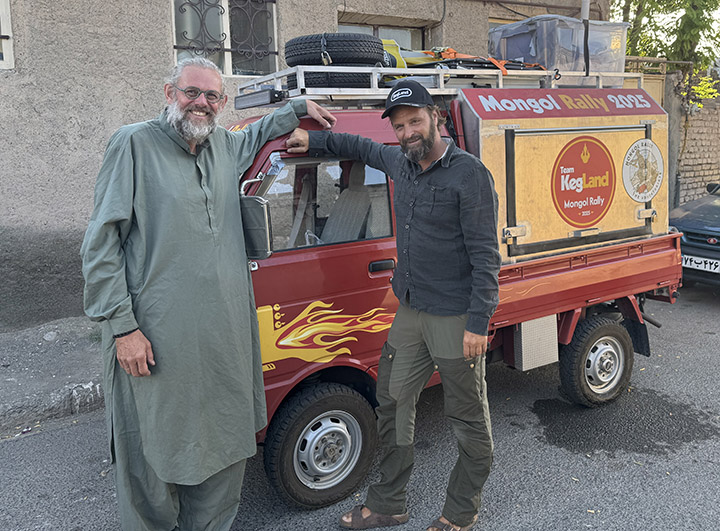
The Mongol Rally is an annual event where people drive small and old cars from Europe to Central Asia. It used to conclude in Mongolia, but for political reasons it now ends in East Kazakhstan. The most common route is to drive south of the Black Sea through Turkey, and then from Azerbaijan across the Caspian Sea to Kazakhstan. We concluded that this ferry ride was a bit unattractive and decided to drive through Iran and Afghanistan instead, but with Russian visas to be able to drive north of the Caspian Sea if the hostilities between Israel and Iran continued. For most participants, the highlight is the Pamir Highway in Tajikistan and Kyrgyzstan, where the highest point is at 15,272 feet (4,655 m) above sea level. This is the site we planned to hit pause on the race to break out our brewing gear and brew a batch of beer. Now, while I cannot say for sure nobody has ever brewed beer at a higher elevation than this, I can say I have been unable to find any mention of it through online searches or asking AI.
One criteria for participating in the Mongol Rally is that the engine size of the vehicle must not exceed 1,000 cc. To be able to brew a batch of beer on the journey, we would need space to bring equipment. In the search for a small car with good space for cargo we ended up with a 1984 Daihatsu Hijet with a 540 cc two-cylinder engine with 28 horsepower. This is a category of cars in Japan, called Kei-car. It is a tax bracket, and the word kei, means light.

It is indeed a long way from Norway to the Ak Baital pass, where we intended to brew — about 8,300 miles (13,000 km). I started from Norway July 8 and drove through Denmark, Germany, and Poland before teaming up in Prague with Kjell for the official start of the Mongol Rally there on July 14. From the starting point in Prague the race is about 7,000 miles (11,000 km), of which I’d guess about a quarter of which is on gravel or off-road conditions. We quickly realized that the choice of car was not perfect, as the max speed of 47 mph (75 km/h) forced us to drive for as much as 14 hours per day. We continued through Slovakia, Hungary, Serbia, Bulgaria, and Turkey. Our intention was to do some brewing in these countries as well, but those brew days were never able to happen as the car was so slow and we needed so many hours on the road every day.

In Turkey our engine stopped and required a new cylinder head gasket, which was not obtainable and a new one was made by hand in Ankara. This delayed our travels by almost a week before we could continue. Turkey is not a small country and only on July 27 could we proceed into Iran. First priority was to go to Tehran to get visas for Afghanistan, which we were granted after an interview with the Taliban at the embassy. To make matters more difficult, the license plates of our car were stolen in Iran. We solved this by going to a nearby town to get new (and fake) Norwegian license plates produced locally. Strictly illegal, but we had no other choice. The guys at the print shop were amazing and refused payment. Overall, we were very impressed and enthusiastic about how friendly and hospitable people in Iran were.

Exiting Iran was no easy feat, as we were interrogated by Iranian intelligence. Knowing that the penalty is death if suspected of being a spy, the episode was very stressful as they looked through our phones and computers, checking photos, social media activities, and contacts. But they allowed us to leave, and then we were in Afghanistan. The road between Herat and Mazar-i-Sharif was more of a track in the sand than a road, and we had to drive for 32 hours non-stop in order to reach our destination. We found out the stress of the previous interrogation was just the beginning of our rising stress, as we were stopped at gunpoint repeatedly by Taliban.
On August 4 we were quite relieved to enter Tajikistan. First of all, we felt safer there. But this was also the nation in which we would do the world record highest brew. After four weeks of driving, we were finally in the right country. First we drove to Dushanbe to get the car fixed. New shock absorbers, rear differential, and the air filter needed some TLC.
And then we could start on the Pamir Highway — a gravel path made by the Soviet Union about a hundred years ago. Day 1 to Kalaikhum at 2,600 feet (800 m) elevation. Day 2 to Khorog at 7,200 feet (2,200 m). The third day was going to take us to Murghab, but the road was too bad and we had to camp (with another Mongol Rally team) in the dessert at 14,100 feet (4,300 m). Subzero temperatures at night and severe altitude sickness the morning after made this very challenging.

The following day we made it to Murghab and at 12,500 feet (3,800 m) this was a good cure for the altitude sickness. Then it was D-day for our brew, and we got started at daybreak. We reached Ak Baital at 15,272 feet (4,655 m) at 10:30 a.m., and rigged up the brewing equipment — a modified KegLand BrewZilla 6.5-gallon (25-L), propane gas-fired system.

We brewed a pale ale with 80% pale ale malt, 10% wheat malt, and 10% Carapils. We mashed at 149 °F (65 °C) and sparged with cold water. It is indeed strange to see boiling occur at 183 °F (84 °C) due to the lower pressure at such a high elevation. Our recipe used 3.5 oz. (100 g) Nectaron® hops, with 0.4 oz. (10 g) added for bittering and the rest at late additions.
The brewing attracted quite a number of spectators, who enthusiastically came over to have a chat. Not that this road is very busy, but during the four hours we were brewing, perhaps as many as 100 people passed us and stopped to chat. One guy from Vietnam was on a bicycle trip and told us that he was also a homebrewer and had KegLand equipment back home in Vietnam. At this elevation the sun is quite intense. We totally underestimated this, and by the time the brewing was done we both had very red faces and necks from sunburn.
We had no way to cool the wort, and it was transferred into heat-proof plastic bags (the ones used for fresh wort kits at Ølbrygging). These were then kept in the car as we proceeded into Kyrgyzstan and found a hostel in Sary Tash, not far from the border. The morning after, the wort was at 88 °F (31 °C), and we transferred it into six KegLand 5-quart (5-L) fermenters (placed inside an insulated cooler) and pitched Kveik Yeastery Stalljen yeast. We fermented at 0.7 bars (10 PSI) of pressure. Even with brewing backgrounds, how this fermentation and pressure control worked as well as it did is a mystery to me as we passed up and down mountains in Kyrgyzstan from 3,300 to 10,000 feet (1,000 to 3,000 m) at least three times. Then it was time to pass customs into Kazakhstan. Upon entrance, authorities decided that our car needed to be X-rayed. I feared they would find the beer and confiscate it, but to our surprise, they did not. And we could proceed to Almaty on August 13.

On August 19 we had a big party at the Ginger Bar in Almaty, where the “Pamir 4655 Ale” was served. The beer was hoppy and smooth. Quite clean, but with some light fruity estery notes. I think the lower boiling temperature made the bitterness lower and made the hop aromas more intense. An aromatic and balanced pale ale was the result. The yeast did not have time to settle completely, so what we served was a bit hazy. We used a picnic faucet and gave small taster servings to all the guests at the bar. Perhaps 7 oz. (200 mL) per serving. We were surprised to see how many Mongol Rally participants showed up for the party, likely close to 100. The feedback on our beer was great, which of course made us very happy that the world’s highest brew was also well received. In fact, many of our guests at the celebration came back for a second and third glass.
The finishing party for the Mongol Rally took place in Oskemen in East Kazakhstan a couple of days later. From Almaty, it is about 600 miles (1,000 km), on a wide and straight freeway crossing flat agricultural lands. Kjell and I concluded that this drive, just for another party, would be pointless, and we decided that we had reached our goal for the trip.
I guess it started with a strong focus on participating in the Mongol Rally, but took a shift to being intent on the brewing and the altitude record. So, we parked our car in Almaty and took a flight to Tbilisi, Georgia, to indulge in qvevri-fermented natural wines before we continued back to Norway. Georgia has the oldest winemaking traditions in the world, and their use of these large, egg-shaped terracotta clay pots to ferment in is very unique. We’d both recommend anyone interested in fermentation to pay it a visit.
And what happened to the little Daihatsu Kei-truck which held up with the relentless beating from thousands of off-road miles in torturous terrain? It was loaded into a container with other Mongol Rally cars to be picked up in the Black Sea port of Constanta in Romania two months later.
The brewing equipment did not share the same fate. It was donated to a clever local Kazakh homebrewer who was thrilled to get all this relatively expensive equipment for free. Hopefully he will put it to good use and make some great beers, which we hope will recruit new people in Kazakhstan to start homebrewing.