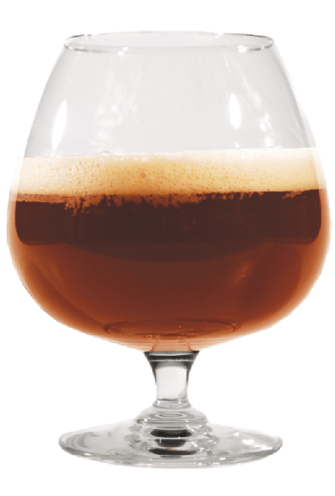
Altbier
Partial Mash Recipe
(6 gallons/23 L, partial mash)
OG = 1.052 FG = 1.012
IBU = 49 SRM = 19 ABV = 5.1%
Ingredients
6.6 lbs. (3 kg) Pilsner liquid malt extract
1.56 lbs. (0.71 kg) Munich malt
0.5 lb. (227 g) red wheat malt
0.75 lb. (340 g) melanoidin malt
0.31 lb. (140 g) crystal malt (60 °L)
0.31 lb. (140 g) debittered black malt
14.6 AAU Perle hops (60 min.) (2 oz./57 g at 7.3% alpha acids)
1.6 AAU Spalt hops (10 min.) (0.5 oz./14 g at 3.2% alpha acids)
0.5 oz. (14 g) Spalt hops (0 min.)
1 gram Whirlfloc® (15 min.)
White Labs WLP036 (Dusseldorf Alt Ale) or Wyeast 1007 (German Ale) or SafAle K-97 yeast
3⁄4 cup corn sugar (if priming)
Step by Step
Using reverse osmosis (RO) water, treat all of your brewing water to a pH of 5.5 using phosphoric or lactic acid. Be prepared to heat two separate pots, one with 7 qts. (6.6 L) and the other with 2 gallons (7.6 L) of water, adding 1⁄4 tsp. of calcium chloride and 1⁄4 tsp. of calcium sulfate (gypsum) to each. Heat the pot with 7 quarts (6.6 L) of water to 156 °F (69 °C) and add all of the bagged grains to be mashed. Verify strike temperature is 144 °F (62 °C) and allow to stand for 25 minutes. While your grains are mashing, heat 2 gallons (8 L) of water to 170 °F (77 °C). This is to help save time while brewing.
Take a small sample of your mash liquid and check for conversion with iodine. Once conversion has been verified, remove your bag of grains and give them a quick soak in your brew kettle to rinse the remaining sugars from the grain. Now gently squeeze your grains to remove the excess liquid. Add the liquid from the mash pot to the brew kettle. Your volume in your brew kettle will be under 4 gallons (15 L).

Boil 60 minutes, keeping the lid mostly on the kettle with a space of an inch or two (3–5 cm) uncovered during the boil. Add hops and Whirlfloc® as indicated. My use of melanoidin malt emulates a decoction-style mash.
At the end of the boil, remove kettle from heat, add all of the malt extract, stirring until dissolved. Then cool partial boiled wort to 80–85 °F (27–29 °C), move to bottling bucket and add refrigerated water to 6-gallon mark (23-L). Allow to rest for one hour, with the bottling bucket tilted so that the spigot side of the bucket is slightly elevated so the trub slides to the opposite side of the bucket. After an hour, open spigot of the bottling bucket, capture the first pint of wort before allowing the rest of the wort to flow into your fermenter. Add the yeast when filling the fermenter.
Ferment at 62 °F (17 °C) and after 3 days allow to rise to 68 °F (20 °C). Once fermentation is complete, rack beer to a secondary and lager for two months at 32 °F (0 °C). Rack beer, prime, and bottle condition (I would recommend adding fresh yeast), or keg and force carbonate.
Tips for Success
I have tested my RO water and my tests show it has a pH of 6, so I do not do any adjustments with phosphoric acid to my water. The RO water you use may have a different pH, so it should be checked and brought to 5.5 if it is not already close.