Belgian-Style Saison
Belgian-Style Saison
(5 gallons/19 L, all-grain)
OG = 1.048 FG = 1.003 IBU = 26.1 SRM = 4 ABV = 5.9%
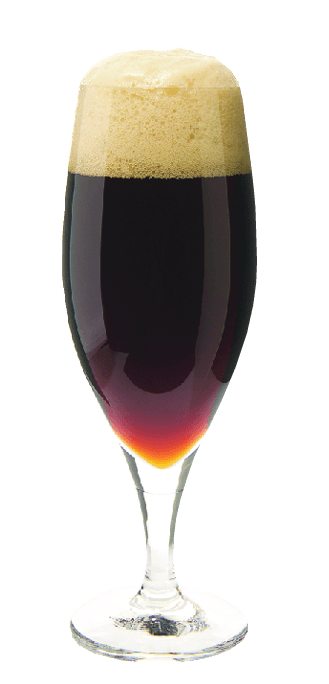
This saison is very dry, with a balanced lemony tartness from the yeast. Flaked wheat adds complexity, body, and smoothness. Rye adds complexity, mainly in the form of spiciness. No aroma hops are used in this version, which focuses on the yeast and grains. For more hop character, I would recommend dry hopping with a noble hop variety or a moderate amount of Motueka and/or Nelson Sauvin.
Ingredients
6.6 lbs. (3 kg) 2-row Pilsner malt
2.2 lbs. (1 kg) flaked wheat
14 oz. (0.4 kg) rye malt
7.4 AAU Hallertau Magnum hops (60 min.) (0.53 oz./15 g at 14% alpha acids)
Wyeast 3726 (Farmhouse Ale) or Wyeast 3724 (Belgain Saison) or starter from the dregs of a bottle of Blaugies beer
1 cup corn sugar (if priming)
Step by Step
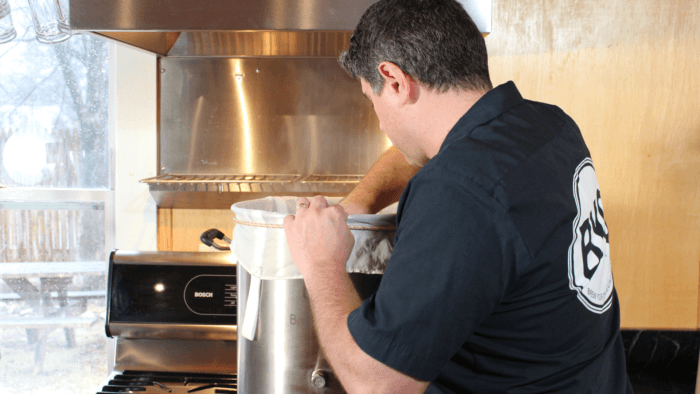
The brewing starts with a 20-minute protein rest performed at 122 °F (50 °C) in 3.5 gallons (13.2 L) of water. At the end of the protein rest, raise mash up to 145 °F (63 °C) to reach the saccharification rest. Maintain the temperature for 75 minutes and before getting to the mash out, make sure to perform an iodine test. This should not be a problem since the amount of unmalted grain is rather limited, but taking extra safety is rarely a bad idea. If the test is negative, bring the mash to 172 °F (78 °C) for 15 minutes. Proceed to vorlauf, with the flow at a moderate speed to avoid a stuck sparge. Sparge with 4.5 gallons (17 L) of water at 172 °F (78 °C).

Bring the wort to a boil and add the bittering hop charge. Maintain the boil for 60 minutes and then proceed to the cooling. Pitch the yeast, aerate, and ferment for four days at 64–68 °F (18–20 °C) or higher if you’re willing to (Blaugies can be fermented at 78+ °F/25+ °C without any trouble). After the initial four days, you can raise the fermentation to 75 °F (24 °C) to help the yeast end fermentation efficiently. Total fermentation usually lasts for 10 to 15 days, depending on the conditions. A maturation of 10 to 15 additional days with stable gravity before cold crashing is highly advised. If you want to add any hop aroma, add a dry hop charge for 4 days before proceeding to the cold crash step. Cold crash at 39 °F (4 °C) for 7–10 days. Bottle or keg as usual.
Belgian-Style Saison
(5 gallons/19 L, partial mash)
OG = 1.048 FG = 1.003 IBU = 26.1 SRM = 4 ABV = 5.9%
Ingredients
4 lbs. (1.8 kg) Pilsen dried malt extract
14 oz. (0.4 kg) 2-row Pilsner malt
2.2 lbs. (1 kg) flaked wheat
14 oz. (0.4 kg) rye malt
7.4 AAU Hallertau Magnum hops (60 min.) (0.53 oz./15 g at 14% alpha acids) Wyeast 3726 (Farmhouse Ale) or Wyeast 3724 (Belgain Saison) or starter from the dregs of a bottle of Blaugies beer
1 cup corn sugar (if priming)
Step by Step
Place grains in a grain bag. The brewing starts with a 20-minute protein rest performed at 122 °F (50 °C) in 1-gallon (3.8-L) of water. At the end of the protein rest, raise mash up to 145 °F (63 °C) in order to reach the saccharification rest. Maintain the temperature for 75 minutes and then perform an iodine test. If the test is negative, bring the mash to 172 °F (78 °C) for 15 minutes. Wash the grains with 1 gallon (3.8 L) of water at 172 °F (78 °C). Top off to 5 gallons (19 L) and add the dried malt extract. Stir until completely dissolved. Follow the remainder of the all-grain recipe.