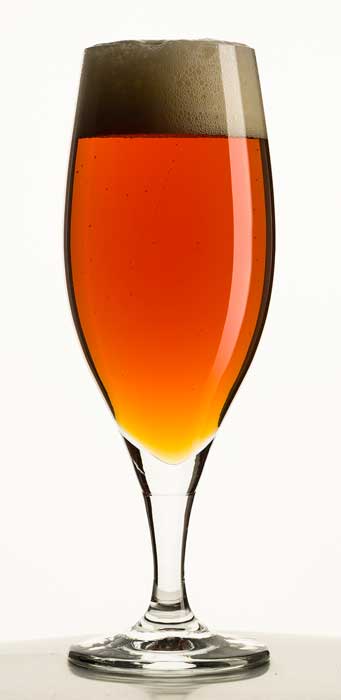
Sapwood Cellars’ Salzig clone
All-Grain Recipe
(5 gallons/19 L, all-grain)
OG = 1.044 FG = 1.006
IBU = 7 SRM = 3 ABV = 5%
The coriander in this Gose provides a beautiful lemon-lime citrusy flavor that only adds to the refreshing qualities of this session beer. Spelt provides additional protein that improves body and head retention, but wheat malt in its place would also make a fantastic beer. Salzig means “salty” in German and rhymes with Leipzig, the town most associated with Gose.
Ingredients
5.25 lbs. (2.4 kg) Weyermann Barke® Pilsner malt
2.6 lbs. (1.2 kg) Weyermann spelt malt
1 lb. (0.45 kg) Best chit malt
0.5 oz. (14 g) Indian coriander
0.25 oz. (7 g) non-iodized salt
88% lactic acid
1 mL HexaHop, TetraHop, or other isomerized alpha acid extract
Omega Yeast OYL-605 (Lacto) blend or Lactobacillus culture of your choice
Brettanomyces culture of your choice
SafAle S-04, LalBrew Nottingham, or Imperial Yeast A01 (House) yeast
1–1.5 cups corn sugar (if priming)
Step by Step
Mash at 148 °F (64 °C), adding 0.25 oz. of table salt and enough calcium chloride to achieve 150 ppm chloride. Add lactic acid if needed to achieve a mash pH of 5.2. Collect wort and boil for 60 minutes. Add crushed coriander and enough lactic acid (approximately 10–15 mL) to the fermenter to achieve a pH of 4.4. Chill to 68 °F (20 °C), aerate, and pitch an active starter of Lactobacillus, yeast, and Brettanomyces. Allow to sour to a pH of 3.3 (or as desired), approximately 12–48 hours. Add hop extract to arrest acidification. Continue to ferment at 68 °F (20 °C). Approximate fermentation time in primary is one month. Once the gravity stabilizes, chill to 55 °F (13 °C). Transfer to a purged keg or bottle prime in Champagne-style bottles for as much CO2 as you are comfortable with (3–4 volumes). You can add additional salt as desired to taste along with the priming sugar.

Extract-Only Recipe
(5 gallons/19 L, extract only)
OG = 1.044 FG = 1.006
IBU = 7 SRM = 3 ABV = 5%
Ingredients
5 lbs. (2.3 kg) weizen dried malt extract
0.5 oz. (14 g) Indian coriander
0.25 oz. (7 g) non-iodized salt
88% lactic acid
1 mL HexaHop, TetraHop, or other isomerized alpha acid extract
Omega Yeast OYL-605 (Lacto) blend or Lactobacillus culture of your choice
Brettanomyces culture of your choice
SafAle S-04, LalBrew Nottingham, or Imperial Yeast A01 (House) yeast
1–1.5 cups corn sugar (if priming)
Step by Step
Starting with 5.25 gallons (20 L) water, heat to 180 °F (82 °C) then remove from heat. Stir in the malt extract until fully dissolved. Hold at this temperature for 10 minutes. Add lactic acid (approximately 10–15 mL) to achieve a pH of 4.4. Chill to 68 °F (20 °C), aerate, and pitch an active starter of Lactobacillus, yeast, and Brettanomyces. Allow to sour to a pH of 3.3 (or as desired), approximately 12–48 hours. Add hop extract to arrest acidification. Continue to ferment at 68 °F (20 °C). Approximate fermentation time in primary is one month. Once the gravity stabilizes, chill to 55 °F (13 °C).
Transfer to a purged keg or bottle priming in Champagne-style bottles for as much CO2 as you are comfortable with (3–4 volumes). You can add additional salt as desired to taste along with the priming sugar.
Tips For Success
If getting pre-isomerized hop product is not possible, the alternate method would be to hold off pitching the ale and Brettanomyces yeast strains until after the souring process is complete (pH ~3.3). Once soured, heat the wort back up to 180 °F (82 °C), add a little bit of hops, then hold for 15 minutes before chilling back to fermentation temperature. Once chilled, add both the yeast strains and follow the instructions found in the step by step.